


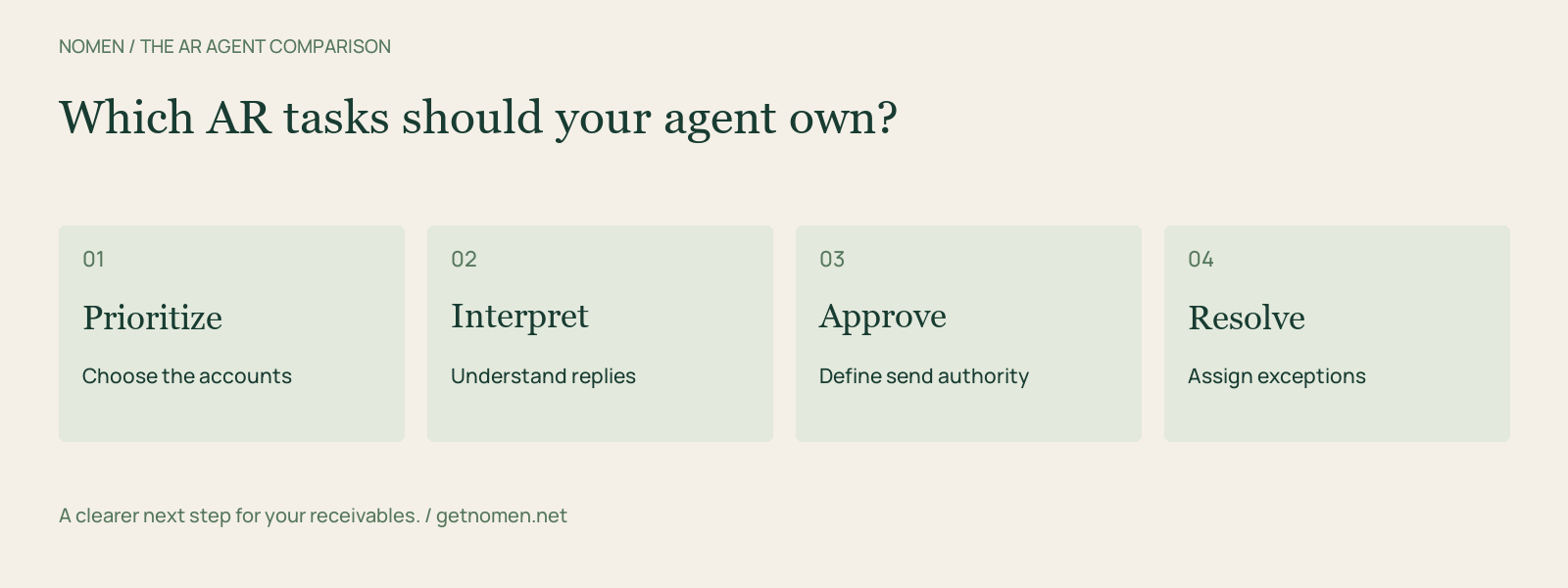
Nomen is worth evaluating when your immediate need is a shared follow-up workspace with draft preparation and explicit approval before sending. Tesorio describes a wider set of AI receivables tasks, including account prioritization, inbound email triage, response drafting, and extraction of payment promises. The useful comparison is which parts of the job your team wants the software to own.
This comparison was written by Nomen from Tesorio's primary product materials reviewed October 21, 2026. It does not report hands-on performance or assume that either product will produce a particular collections result.
What does each product automate?
Nomen's optional Auto workflow selects eligible follow-ups using configured policy and invoice facts, then prepares drafts when a user runs it. AI helps with wording; it does not independently choose recipients or override eligibility rules. Each saved email needs a separate approval and send action.
Tesorio's Collections Agent materials describe AI prioritization, classification of incoming AR emails, contextual response drafts, payment-promise extraction, and escalation signals. They also describe drafts available for a person to review or send. Establish the approval settings for the particular workflow you would use rather than treating “AI agent” as a single operating mode.
Source: Tesorio Collections Agent product page, reviewed October 21, 2026.
| Decision | Nomen | Tesorio |
|---|---|---|
| Immediate use case | Organize and prepare the next follow-up | Coordinate a wider set of AR agent tasks |
| Follow-up selection | Configured eligibility rules; run on demand | Documents AI prioritization |
| Message control | Explicit approval before sending each saved email | Documents response drafting and human review options |
| Customer commitments | Recorded active promises hold Auto proposals | Documents extraction of promises from customer replies |
| Additional scope to investigate | Confirm the connections available in your workspace | Separate supplier-portal and other AR offerings |
Why does payment-promise handling matter?
A payment promise should identify the amount, covered invoices, date, and person making the commitment. “We'll pay next week” may refer to only part of a balance. A team's job is to distinguish that statement from a confirmed payment.
In Nomen, recorded active promises hold Auto follow-up proposals. Tesorio documents extracting commitments and dates from replies. Those are different functions: recording a commitment, interpreting a message, and deciding how it affects outreach should each be tested.
Use a partial-payment example in the demo. Ask what gets recorded, whether someone can correct it, and what happens to the remaining balance. This reveals more than a demonstration built around one unambiguous promise.
What if customers require invoices in procurement portals?
Tesorio separately documents supplier-portal agents that submit invoices, monitor payment status, and retrieve remittance information, including work in Coupa and Ariba. Verify which portals and actions are included in the proposed package.
Source: Tesorio Supplier Portal Automation product page, reviewed October 21, 2026.
A reminder alone cannot fix an invoice that the customer has never accepted into its required portal. If portal administration consumes most of the team's time, include that work in the buying criteria. Nomen should be evaluated against its established follow-up scope; automatic submission to customer procurement portals is not a capability established by this review.
How should you evaluate integrations and cost?
Tesorio's integration materials describe connections across accounting, CRM, banking, email, and customer portal systems, including data written back to the ERP. Confirm the exact records, permissions, and directions needed for your account.
Source: Tesorio Integrations page, reviewed October 21, 2026.
For Nomen, begin with the documented invoice-file import route and confirm production native-connector availability. For both products, reconcile imported balances against the accounting system and identify who owns failed updates.
No numerical Tesorio subscription rate was established in the primary pages reviewed. Obtain a proposal that identifies the required modules, setup, usage, and support. Compare the resulting scope with Nomen's current plans, rather than assuming that a smaller product automatically costs less for every team.
Could the existing workflow still be enough?
Yes, if the team can consistently assign invoice owners, record commitments, and act on exceptions. Before replacing a spreadsheet, check whether your problem is missing software or an unclear process. A new system needs an owner for the same facts.
Which should you shortlist?
Shortlist Nomen for a focused, approval-based follow-up process. Investigate Tesorio when the requirements include a broader set of AR agent tasks, customer-reply interpretation, or separately scoped portal work.
Test an overdue invoice, an ambiguous payment promise, and a disputed balance. Ask who can correct the interpretation, stop outreach, and continue the work if automation fails. Both the software and the person covering the account should be able to explain the outcome.
For broader finance automation, read Nomen vs Maximor, now Hyphenate. For another AR agent approach, read Nomen vs Fazeshift.
Put your next follow-up in focus. Explore how Nomen works and current plans.
Turn a reminder into a repeatable workflow.
See overdue invoices and prepare your next follow-up in Nomen.
Get started