


Nomen and Maximor address different scopes of finance work. Nomen focuses on organizing invoice follow-ups, preparing drafts, and approving messages before sending. Maximor, which rebranded as Hyphenate on October 1, 2026, positions itself as an autonomous finance platform. Its order-to-cash offering includes collections within a broader flow from contracts and billing to payment application.
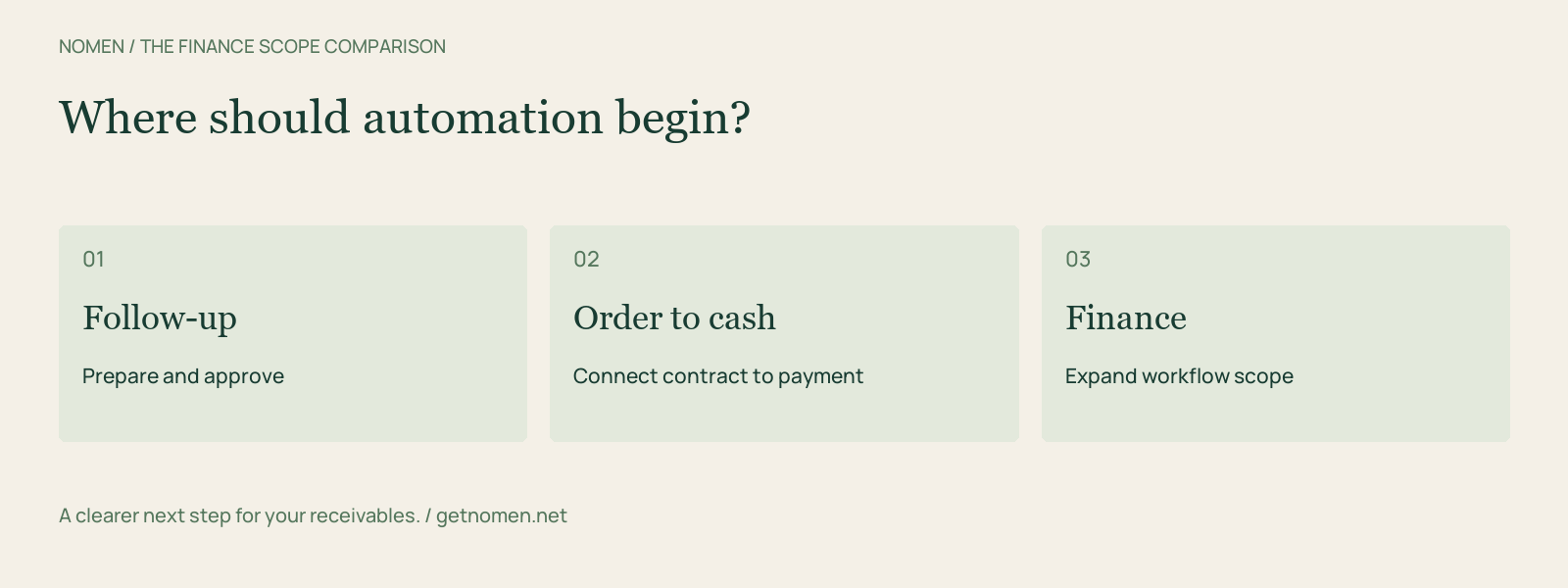
The first buying decision is scope: do you need a clearer collections process, or do you want software to execute work across several finance functions?
This comparison was written by Nomen from primary product documentation reviewed October 21, 2026. It is a comparison of documented capabilities, not a hands-on benchmark. Source references appear by name throughout; the research record is maintained by the editorial team.
Is Maximor the same company as Hyphenate?
Yes. The company's October 1 announcement states that Maximor rebranded as Hyphenate. This article retains Maximor in the title for readers searching under the former name and uses Hyphenate when discussing the current product.
Source: Hyphenate, “Maximor Rebrands as Hyphenate,” October 1, 2026.
What is the main difference between Nomen and Hyphenate?
Nomen provides a workspace for collection priorities, customer context, history, and message preparation. Its optional Auto workflow proposes eligible follow-ups on demand. A saved email requires explicit approval before sending through an authorized Gmail connection.
Hyphenate's platform materials describe agents across revenue, cash, accounting, and reporting, with people handling judgment and exceptions. Its order-to-cash page describes automated invoice generation, always-on collection follow-ups, and cash application. That broader scope is relevant when overdue invoices are one part of a larger finance automation project.
Sources: Hyphenate Platform and Order-to-Cash product pages, reviewed October 21, 2026.
| Decision | Nomen | Maximor / Hyphenate |
|---|---|---|
| Starting scope | Invoice follow-up work | Finance workflows, including order-to-cash |
| Collection execution | On-demand proposals and drafts, followed by explicit send approval | Documents always-on collection follow-ups |
| Human involvement | Approval of each saved email | Documents escalation of judgment and exceptions |
| Starting data | invoice-file import imports; confirm native connection availability | Describes a platform layered over existing finance systems |
| Evaluation priority | Can the team manage its next follow-up clearly? | Which processes should agents execute across systems? |
Does a broader platform remove the need for human control?
No. Breadth and approval design are separate questions. A platform may automate more steps while still providing review or escalation controls. Do not assume that an autonomous product offers no oversight, or that every action is reviewed in the same way.
Write down which actions need a person: a routine reminder, a changed payment instruction, a credit decision, or a disputed balance. Ask for a demonstration of those boundaries using test records. A useful control is one your team can explain and apply consistently.
Which approach fits a small collections team?
A focused workflow is worth evaluating when the main problem is scattered context: the balance is in accounting, the promise is in email, and the next action is in someone's memory. Nomen addresses that working process without requiring the buying decision to include close, payables, or reporting automation.
A wider platform deserves consideration when several finance workflows need coordinated execution. Map that project before comparing subscriptions. Identify the systems, data owners, permitted actions, and exceptions that must move together.
How should you compare pricing and implementation?
No numerical Hyphenate subscription price was established in the primary pages reviewed. Obtain a scoped proposal covering the workflows and connections you need. Compare it with the current Nomen plans, including draft usage and any enabled overages.
Ask what is included in setup, who maps the data, and who handles exceptions after launch. A vendor's statement that the ERP stays in place does not tell you how much process work your team must do.
For Nomen, invoice-file import provides a starting path. Confirm production connector readiness before making a native integration part of the purchase requirement. Test current balances and active customer commitments before live outreach.
When is the existing accounting workflow enough?
Keep the existing process if a colleague can reliably find the open balance, latest customer commitment, and next action without rebuilding the account history. A well-maintained tracker can remain useful while the team defines a wider project.
If that coverage test fails, start with the smallest change that resolves it. If the problem extends into billing and payment application, include those steps in the evaluation rather than expecting a reminder tool to cover them implicitly.
What should you test before choosing?
Use a test account with one overdue invoice, a partial payment, and a promise covering the remainder. Ask each product to explain the next action, show the approval boundary, and record what happened. For a broader project, extend the test back to the contract and forward to the accounting entry.
Compare another agent approach in Nomen vs Tesorio or Nomen vs Fazeshift.
Start with the work your team needs to manage. Explore Nomen's collections workflow and current plans.
Turn a reminder into a repeatable workflow.
See overdue invoices and prepare your next follow-up in Nomen.
Get started